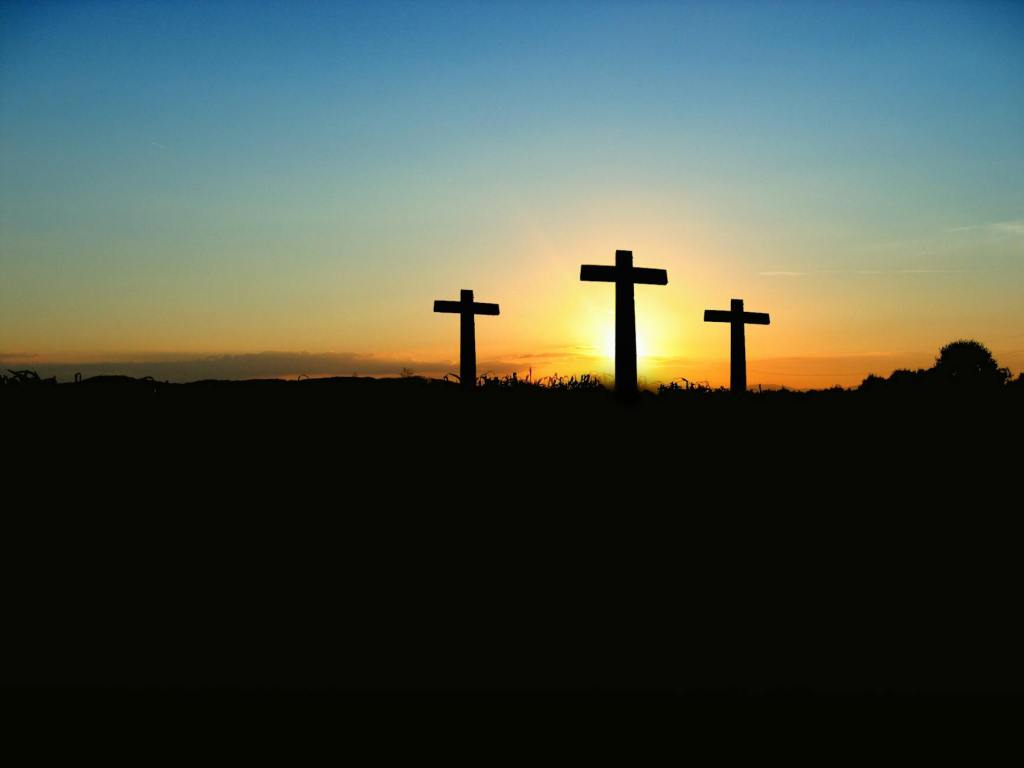
Gal. 5:24-26
Introduction
We have just finished the Fruit of the Spirit. The nine characteristic of the Holy Spirit filled life. If we fully surrender ourselves to the indwelling Holy Spirit, we will be able to subdue the works of the flesh and live our lives pleasing our Lord and Saviour Jesus Christ.
I. Our Conversion (Gal. 5:24a)
A. And they that are Christ’s
- This term means “all who are true Christians”.
- There is a distinction made between they that are Christ’s and they that are not.
- The believer belongs to God. He is bought with a price (1 Cor. 6:20). Not everyone is a Christian
- The liberals teach the Fatherhood of God and the brotherhood of man. There is no such doctrine. To the unsaved, Jesus said, Ye are of your father the devil. (John 8:44).
- One must be born again to be a child of God.
Illustration 1: Conversion
The decisive act in which a sinner turns away from sin in genuine repentance and accepts the salvation that Christ offers. The imagery in conversion is that of turning. A person is going along a road and realizes that he or she is on the wrong track. They will never reach the destination if they continue in that direction. So, the person “turns,” or “is converted.” He or she ceases to go in the wrong direction and begins going in the right one. Conversion changes the direction of one’s course of life from the wrong way to the right way, the way that God wants.
The Shaw Pocket Bible Handbook, Walter A. Elwell, Editor, (Harold Shaw Publ., Wheaton, IL; 1984), p. 347
II. Our Crucifixion (Gal. 5:24b)
A. Paul teaches that the believer is identified with Christ in His death, burial, and resurrection (Rom 6). Christ not only died for me, but I died with Christ. Christ died for me to remove the penalty of my sin, but I died with Christ to break sin’s Power.
B. At the moment of salvation God declares the flesh to be dead. The “flesh” here means the corrupt passions of the soul, while “affections” means “all corrupt desires”. “Lusts” means longings (especially for what is forbidden). They are as though they were dead, and have no power over us. As far as God is concerned every believer’s old nature is dead and nailed to the cross. Because of the new birth and the indwelling presence and power of the Holy Spirit, the flesh has been rendered powerless. Let not sin therefore reign in your mortal body, that ye should obey it in the lusts thereof. (Rom. 6:12)
C. Though the flesh is considered dead, the spiritual battle still goes on inside the believer (Rom. 7:14-25).
D. Christians must wait until their glorification until they are finally free from their unredeemed humanness (Rom. 8:23).
III. Our Behaviour (Gal. 5:25)
A. If we live in the Spirit, that is, if the Spirit lives in us, if the holy Spirit of grace be the principle of our life, let us walk in the Spirit:
- Walking in the Scriptures often denotes how we live, how we act, or how you conduct yourself.
- Let us live and act under the conduct and guidance, under the direction and influence, of the Holy Spirit;
- Let us do the works of the Spirit, let us bring forth the fruits of the Spirit, and let us live a spiritual life
- Let our dealings be about spiritual and heavenly things, and our chiefs delight be in such things; and by these spiritual delights and exercises we shall every day become more and more spiritual, and in the account of God by esteemed and reckoned amongst the number of those that walk in the Spirit
- Let us then evidence the life of grace in ourselves, by exercising that grace in a life of communion with God. This seems to be the import of this remarkable place, If we live in the Spirit, let us also walk in the Spirit.
Illustration 2: The Princeton Religion Research Center has measured the impact of religion on day-to-day work. Comparing the “churched” with the “unchurched” on a wide range of behaviours like pilfering supplies (stealing), overstating qualifications on resumes (lying), calling in sick when not sick (lying and stealing), and overstating tax deductions (lying, stealing, and cheating), the center finds “little difference in the ethical views and behavior of the churched and the unchurched.” What differences there are “are not significant or are of marginal significance.”
William Hendricks, in Christianity Today, Nov. 25, 1991
IV. Our Self-denial (Gal. 5:26)
A. Let us not be desirous of vain glory, provoking one another, envying one another.
- Putting others first is the main thought here
- To put others first is a work of the Holy Spirit and is completely contrary to depraved human nature.
- The sin of being desirous of vain glory is a sin which causes a lot of trouble among Christians. The phrase vain glory comes from the Greek “kenodoxos” and speaks of self-conceit and arrogance. It describes someone who tries to appear as something more than he is. Vain glory is the sin of setting oneself above fellow Christians. It is the sin of over estimating one’s self-worth. The exaltation and praise of self is a pride to the related work of the flesh.
- Vain glory results in … provoking one another, envying one another. (Galatians 5:26) It is a fleshly work that promotes jealously and envy. It leads to disruption and disunity. It is a sin driven by pride and man thinking more highly of himself than he ought to.
Illustration 3: Self Denial
Jesus Christ demands self-denial, that is, self-negation (Matt. 16:24; Mark 8:34; Luke 9:23), as a necessary condition of discipleship,. Self-denial is a summons to submit to the authority of God as Father and of Jesus as Lord and to declare lifelong war on one’s instinctive egoism. What is to be negated is not personal self or one’s existence as a rational and responsible human being. Jesus does not plan to turn us into zombies, nor does he ask us to volunteer for a robot role. The required denial is of carnal self, the egocentric, self-deifying urge with which we were born and which dominates us so ruinously in our natural state.
Jesus links self-denial with cross-bearing. Cross-bearing is far more than enduring this or that hardship. Carrying one’s cross in Jesus’ day, as we learn from the story of Jesus’ own crucifixion, was required of those whom society had condemned, whose rights were forfeit, and who were now being led out to their execution. The cross they carried was the instrument of death. Jesus represents discipleship as a matter of following him, and following him as based on taking up one’s cross in self-negation. Carnal self would never consent to cast us in such a role. “When Christ calls a man, he bids him come and die,” wrote Dietrich Bonhoeffer. Bonhoeffer was right: Accepting death to everything that carnal self wants to possess is what Christ’s summons to self-denial was all about.
J. I. Packer, Hot Tub Religion, (Living Books, Tyndale House Publ., Inc., Wheaton: 1987), pp. 72-73.
V. Conclusion:
Those who belong to Christ are they who had Crucified the flesh in both principle and practice. Are you one of them? Have you repented from your sins and received Christ as your personal Saviour? Then you are one of those who have crucified the flesh.




Leave a Reply