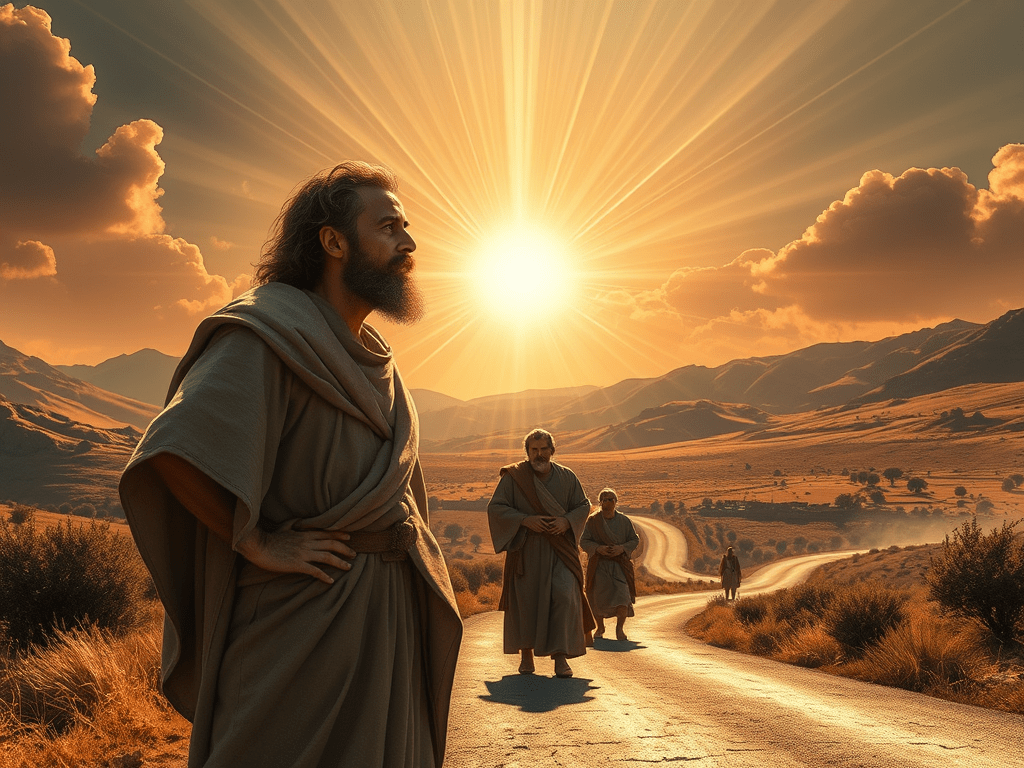
Gal. 1:10-16
Introduction
Paul here writes his personal experiences before he came to know the Lord Jesus Christ, and the events in his early Christian life. He also depends his authority here as an Apostle.
I. He is not a man pleaser (Gal. 1:10)
A. Paul wasn’t interested in being popular. He had only one motive and that was to please the Lord Jesus Christ. He knew that it was impossible to please both man and God. There is no middle ground when it comes to serving Christ. Jesus must come first. Jesus said, “No man can serve two masters” … (Matthew 6:24) Paul never played politics. He never wanted to bring honor to himself. All he wants was to magnify and honor Christ.
II. He received his Gospel personally from Christ (Gal. 1: 11-14).
A. Paul saw the risen Christ (Acts 9) and received his commission and message directly from Him. This experience qualified him to be an apostle. Paul was never meant to be the twelfth apostle to replace Judas (Acts 1:16-26). For one thing, Paul could not have met the qualifications; also, God deliberately kept Paul separated from the Twelve so no one could accuse Paul of borrowing his message. Nobody could accuse Paul of inventing his message, because he had been a persecutor of the church, not a friend. His life was radically changed after he met Christ on the Damascus road. The only way to explain such a remarkable transformation is to accept the fact that Paul met the risen Christ.
- Paul certifies that the gospel did not originate with man. Man-made religions emphasize human merit and the necessity of human works for salvation. Paul’s message did not.
- He also tells that he did not receive the gospel from any human source. Though he heard Stephen preach.
- Paul affirmed he did not receive the gospel he preached by means of some course of instruction. Even though that was the way the Galatians received the gospel (as Paul had instructed them), the apostle on the other hand received it by revelation from Jesus Christ. This was the highest authority. How then could the Galatians question his authority and message? And how did they dare deviate from this divinely revealed truth?
- The word “revelation” here means uncovering, a bringing to light of that which had been previously wholly hidden or only obscurely seen. God has been pleased in various ways and at different times (Heb. 1:1) to make a supernatural revelation of himself and his purposes and plans, which, under the guidance of his Spirit, has been committed to writing. The Scriptures are not merely the “record” of revelation; they are the revelation itself in a written form, in order to the accurate preservation and propagation of the truth. (Illustrated Bible Dictionary).
III. His Former life as a persecutor (Gal. 1:13-14)
- Paul goes on to say, …how that beyond measure I persecuted the church of God, and wasted it: (Galatians 1:13) Webster defines persecution as meaning, “harassed by troubles or punishments unjustly inflicted, particularly for religious opinions.” Paul was a militant legalist who despised with vengeance anyone who would name the name of Christ. The word wasted comes from “portheo” and means “to waste, to ravage, to destroy.” The idea is that of plundering a defeated city. Paul’s desire and intent were to completely eradicate the Church. This is what he lived for.
- In Acts 8:1, as Saul, he participated in the execution of Stephen, the first martyr. “And Saul was consenting unto his death”. The word consenting means to “think well of, assent to, feel gratified with, assent, be pleased, have pleasure in.” So caught up was Paul in his religion and persecution of the Church that he actually felt gratified and pleased at the stoning of Stephen. The tense of the words persecuted and wasted indicate that this was a continual way of life for Paul. He lived to persecute the Church (Acts 8:3, 9:21; 22:3-5,19-20; 26:10,11; 1 Timothy 1:12-13). Paul was convinced that he was actually doing God’s work by persecuting the Church.
Illustration: China’s Boxer Rebellion
During China’s Boxer Rebellion of 1900, insurgents captured a mission station, blocked all the gates but one, and in front of that one gate placed a cross flat on the ground. Then the word was passed to those inside that any who trampled the cross underfoot would be permitted their freedom and life, but that any refusing would be shot. Terribly frightened, the first seven students trampled the cross under their feet and were allowed to go free. But the eighth student, a young girl, refused to commit the sacrilegious act. Kneeling beside the cross in prayer for strength, she arose and moved carefully around the cross, and went out to face the firing squad. Strengthened by her example, every one of the remaining ninety-two students followed her to the firing squad.
Today in the Word, Feb. 89, p. 17
IV. His Conversion (Gal. 1:15-16a)
A. Here Paul simply enumerated three things God did for him.
- God set him apart from birth. Paul knew that God had providentially set him apart from birth and that all his life to this point was a preparation for his ministry as a proclaimer of the gospel of God’s grace.
- God called Paul by His grace. This is a reference to the time of Paul’s salvation. He responded to God’s efficacious call and received Jesus Christ as Savior. In Romans (8:30) Paul gave the sequence of God’s work in salvation: “Those He predestined, He also called; those He called, He also justified; those He justified, He also glorified.”
- God was pleased to reveal His Son in Paul. Blinded as he had been to the deity of Jesus Christ and thinking that the Nazarene was a fraud, God gave Paul an outward vision of Christ on the Damascus Road and later an inner revelation concerning the full significance of the person and work of the Savior. The purpose of this revelation was that Paul might preach Him among the Gentiles. The Book of Acts gives full account of Paul’s ministry to the non-Jewish world on his missionary journeys. He became known as the apostle to the Gentiles (cf. Acts 9:15; 13:46-47; 26:20; Rom. 11:13; 15:16; Eph. 3:8; 1 Tim. 2:7). Thus, Paul emphasized that both his conversion and his commission owed nothing to man but were of God. How else could such a transformation – from persecutor to preacher – be explained?
Illustration: A Definition of Conversion
The decisive act in which a sinner turns away from sin in genuine repentance and accepts the salvation that Christ offers. The imagery in conversion is that of turning. A person is going along a road and realizes that he or she is on the wrong track. They will never reach the destination if they continue in that direction. So, the person “turns,” or “is converted.” He or she ceases to go in the wrong direction and begins going in the right one. Conversion changes the direction of one’s course of life from the wrong way to the right way, the way that God wants.
The Shaw Pocket Bible Handbook
V. Conclusion:
Paul a church persecutor and an accomplished for the death of the first Christian martyr met Christ in Damascus road and was converted. A turning point in history which have affected the whole world. The gospel Paul was preaching was a direct revelation from Jesus Christ. Christ died for you will you repent from your sins now and receive Him as your personal Saviour?





 Gospel Bible Baptist Church
Leave a comment